Two services show up in almost every South Florida detailing quote: paint correction and ceramic coating. They get bundled together so often that a lot of car owners assume they’re the same thing, or that one automatically includes the other. They don’t, and mixing them up is the fastest way to overpay for the wrong service. If you’re comparing paint correction in Miami to ceramic coating in Miami, the short version is this: correction fixes what’s already wrong with your paint, and coating protects the paint once it’s right.
The rest of this comes down to what each service actually does, why the order between them matters, and how Miami’s climate changes the math.
What Paint Correction Actually Does
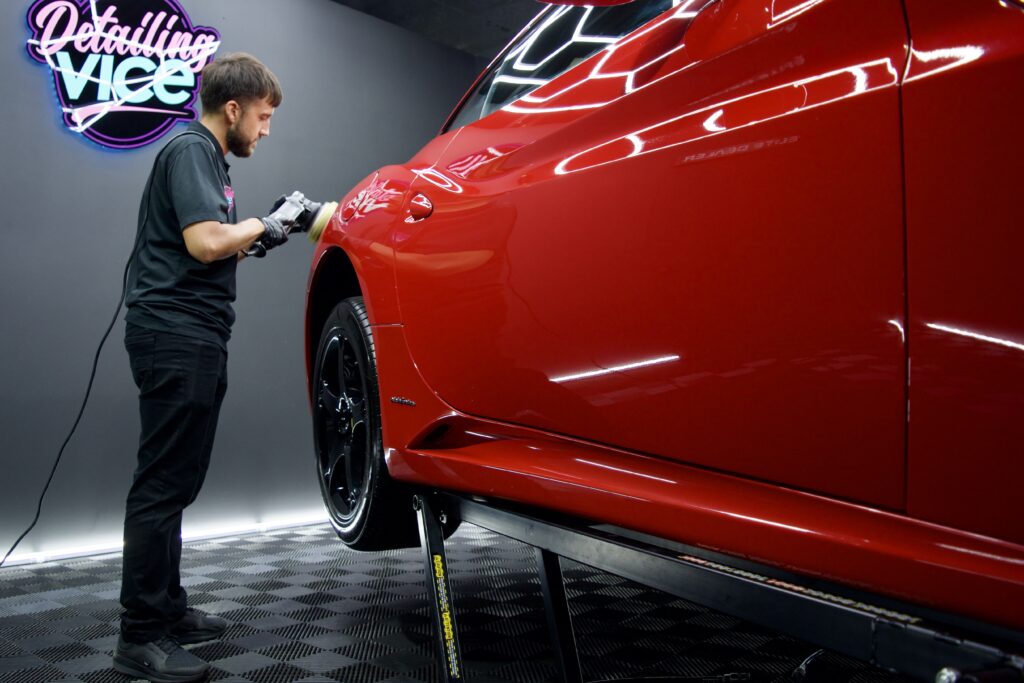
Paint correction is a mechanical process. A trained technician uses a polisher, either a dual action (DA) or rotary machine, along with compounds and pads matched to your paint’s hardness, to remove a thin layer of clear coat and take the swirl marks, oxidation, water spots, and scratches with it.
It’s not a coating, a wax, or a sealant. It’s closer to sanding and buffing a piece of furniture until the surface is level and clear again. The goal is optical: light bounces evenly off corrected paint instead of scattering off thousands of tiny scratches, which is what creates that “wet glass” look on a freshly corrected car.
Correction comes in stages:
- One-step correction removes light swirls and haze. Fast, lower cost, good for regular maintenance.
- Multi-stage correction removes deeper scratches and oxidation in successive passes, each with a coarser compound followed by finer polishing.
- Single-stage paint correction is its own category entirely. Cars with lacquer or single-stage enamel, common on classics and vintage models, have no clear coat layer to protect the color. [INTERNAL LINK: link to paint correction service page] There’s far less margin for error, which is why this work should never be treated the same as correcting a modern clear-coated exotic.
Every paint job has a finite amount of clear coat. A car that’s been aggressively corrected multiple times has less material left to work with, which matters for how often correction can realistically be repeated.
What Ceramic Coating Actually Does
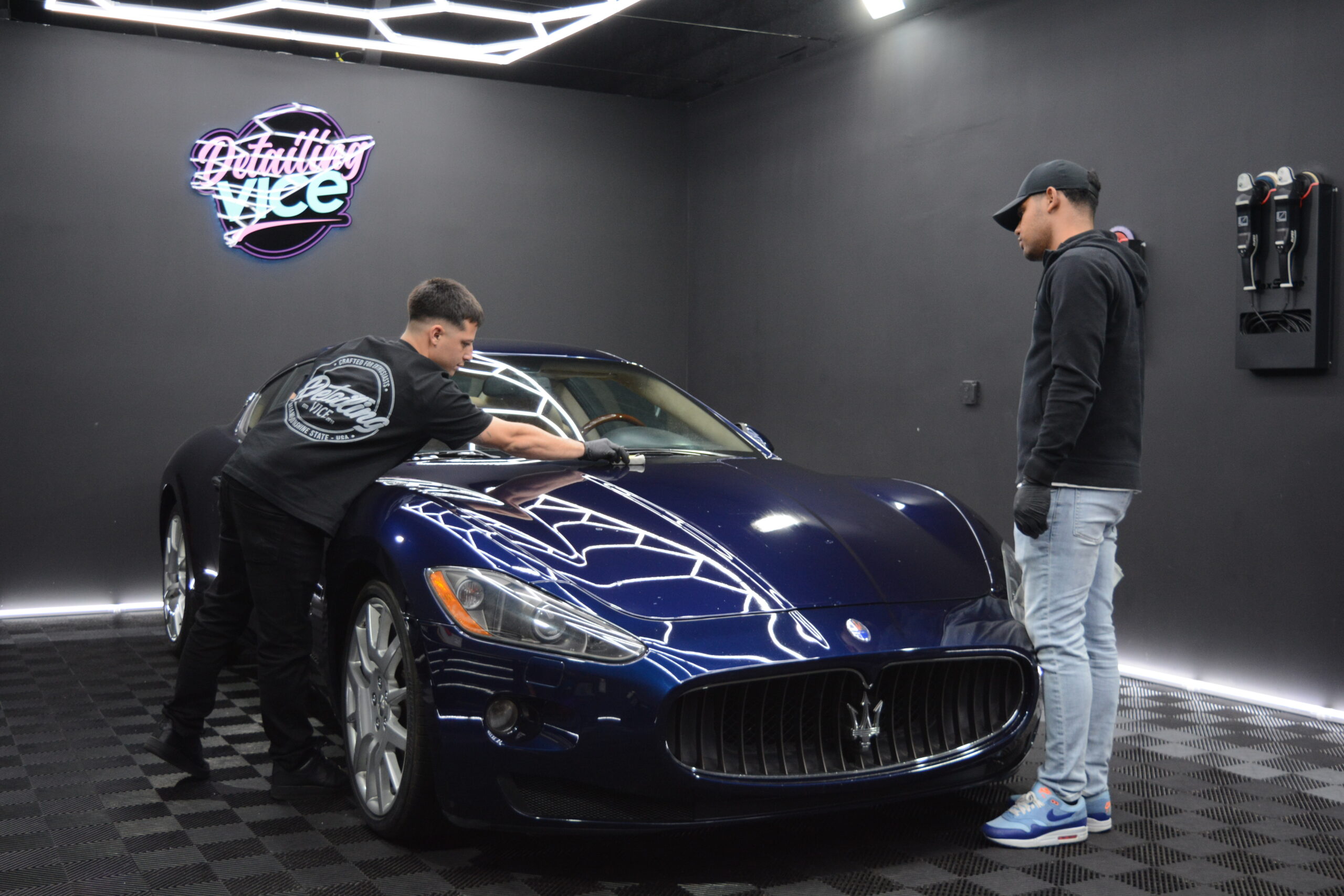
Ceramic coating is a liquid polymer, typically silica or quartz based, that chemically bonds to the clear coat (or to bare single-stage paint, when formulated for it) and cures into a hard, glossy layer on top of the paint. Unlike wax or sealant, it doesn’t wash away or break down after a few months.
A properly applied coating gives you:
- Hydrophobic beading, so water and contaminants sheet off instead of sitting on the surface
- UV resistance, which slows down oxidation and fading
- Chemical resistance against bird droppings, tree sap, brake dust, and road salt
- A harder outer surface that resists light scratching from washing, though it does not prevent rock chips or deep scratches
Coatings are typically rated by durability: 3-year, 5-year, or 10-year formulas, with annual inspections recommended to check the coating’s condition and reapply maintenance products.
One thing coating does not do: it does not fix existing swirl marks, oxidation, or scratches. Whatever condition the paint is in when the coating goes on is the condition it locks in, just with a glossy, protected finish on top.
Why the Order Matters
This is the part that trips people up. Ceramic coating should always go on after paint correction, never before.
Here’s why. Coating bonds to whatever surface it’s applied to. If that surface has swirl marks, holograms, or oxidation, the coating seals those flaws in place under a hard, durable layer that isn’t coming off for years. You end up with paint that beads water beautifully and still looks tired up close, because the coating protected the damage instead of the paint.
Correcting the paint first means the coating is sealing a surface that’s already been leveled and polished. That’s the only way to get the deep, reflective look people associate with ceramic coating in Miami’s high-sun, high-glare conditions.
Do You Need Both, or Just One?
Not every car needs both services, and a good detailer should tell you that even when it costs them the upsell.
- New or well-maintained paint with minimal swirling can often go straight to coating, skipping a full multi-stage correction.
- Daily drivers with visible swirl marks and water spots usually benefit from a one-step correction before coating, so the gloss improvement actually holds up.
- Classics, vintage cars, and anything with single-stage or lacquer paint need an experienced eye before either step. Aggressive correction on thin, original paint can do permanent damage, and not every coating formula is safe on those surfaces.
- Cars that just need protection, not a cosmetic fix, might be fine with coating alone, assuming the paint is already in good shape.
The only way to know for sure is a paint inspection under proper lighting, which is why pricing for both services should always follow an in-person look at the car rather than a number quoted over the phone.
Miami Conditions That Change the Calculation
South Florida isn’t a neutral environment for paint. A few local factors push more cars toward doing both services rather than skipping straight to one:
- UV load. Miami’s sun accelerates clear coat oxidation faster than most parts of the country, which is exactly what ceramic coating’s UV resistance is built to slow down.
- Salt air, especially for cars stored or driven near the coast in Aventura, Sunny Isles Beach, or Hallandale Beach, speeds up corrosion and dulls paint faster than inland conditions.
- Summer rain and mineral spotting. Frequent afternoon storms mean more water sitting on paint, which is where hydrophobic coating earns its keep.
- Love bug season brings acidic residue that can etch into unprotected clear coat within hours if left uncleaned, another argument for a coated, easier to clean surface.
None of these conditions cause damage that correction alone or coating alone can fully solve long term. They’re the reason so many Miami owners end up doing correction once, then maintaining protection with coating for years afterward.
What This Costs in Miami
Neither service has a fixed price, and any shop quoting a flat number without seeing the car first is guessing. Cost depends on:
- Vehicle size and paint surface area
- How many stages of correction the paint actually needs
- Whether the paint is modern clear coat or single-stage/lacquer, which requires more careful, often slower work
- Coating tier and warranty length (3, 5, or 10 years)
- Any prep work needed before either service, such as decontamination or claying
A proper quote comes from an in-person inspection under good lighting, not a phone estimate.
Frequent Asked Questions
Not always. If the paint is already in good condition with minimal swirling, a light polish or single-step correction may be enough before coating. Cars with visible scratches, oxidation, or water spots need a fuller correction first so the coating seals a clean surface.
No. Coating adds gloss and protection, but it locks in whatever the paint looked like before application. Scratches, swirl marks, and oxidation need to be corrected first if you want them gone.
Yes, when the right formula is used and a test panel is done first. Single-stage and lacquer paints behave differently than modern clear coat, so this work should go to a shop with specific experience on vintage finishes.
The correction itself is permanent since it physically levels the clear coat. What fades over time is the shine, as new swirl marks accumulate from washing and driving. A ceramic coating applied afterward slows that process significantly.
You can, and it’s a reasonable choice if the paint is already in solid shape. It’s not a shortcut if the paint has visible flaws, since the coating will preserve those flaws rather than fix them.
Ready to Find Out What Your Car Actually Needs
The only way to know whether your car needs correction, coating, or both is to have it looked at in person. Our studio in Miami inspects every vehicle under proper lighting before recommending a service, whether it’s a daily driver picking up road grime or a concours-bound classic that needs a specialist’s hand. Reach out to schedule an inspection and get a real answer, not a guess.