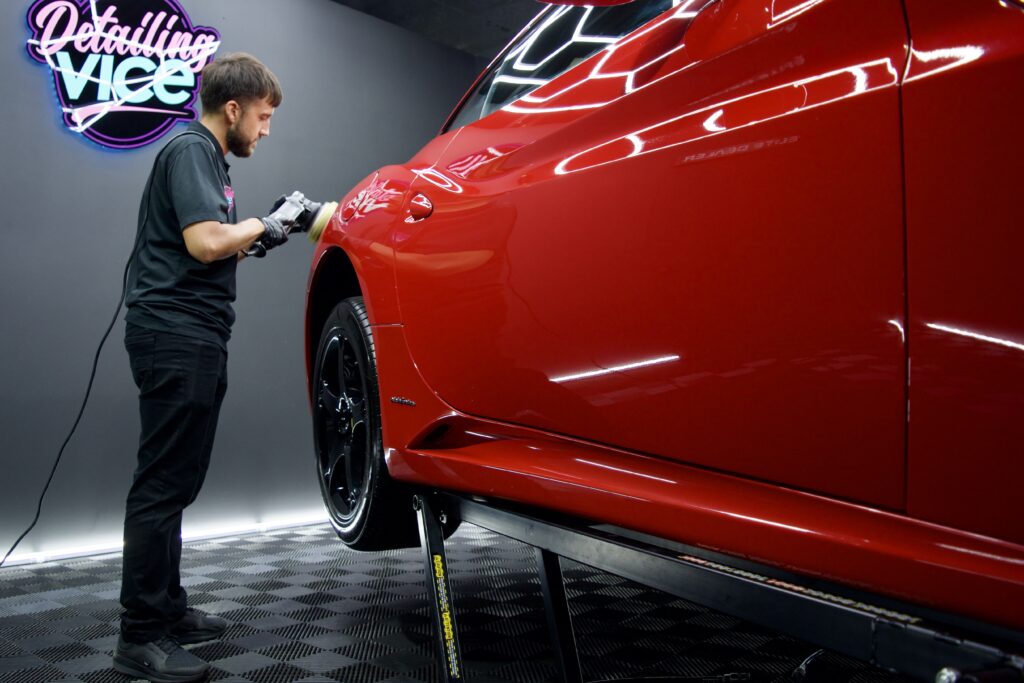
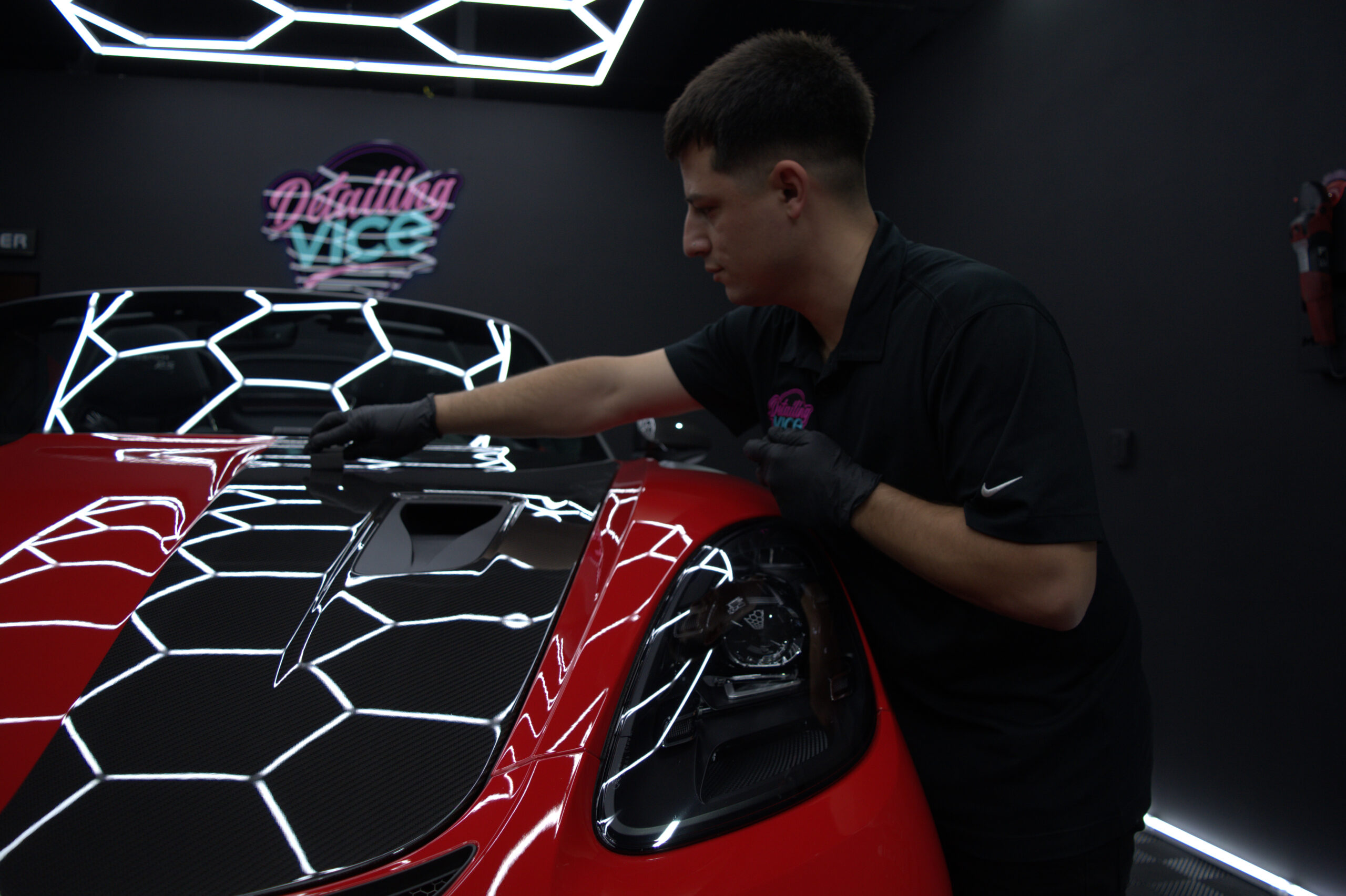
Ask ten detailers whether you can ceramic coat a classic car with original single-stage paint and you’ll get ten different answers. Some will tell you it’s perfectly safe. Others won’t go anywhere near a vintage finish. The real answer lives somewhere in the middle, and understanding exactly where is what separates a coating that preserves your car for a decade from a process that permanently dulls a finish it took fifty years to earn.
At Detailing Vice, classic and vintage cars aren’t a side service. They’re the reason the studio exists. We’re one of the few shops offering ceramic coating in Miami that specializes in original single-stage and lacquer finishes, not just modern clear coat. So when a collector asks whether their numbers-matching muscle car or original-paint European should be coated, we don’t give a blanket yes or no. We give the answer this article walks through. Yes, single-stage and lacquer finishes can be ceramic coated beautifully, but only when the preparation is built around the paint instead of around a modern clear coat.
First, what makes single-stage paint different
Nearly every car built in the last thirty years wears a basecoat/clearcoat system. A pigmented color layer goes down first, then a separate clear protective layer seals it. When a detailer polishes or coats a modern car, they’re working on that clear layer, and the color underneath never gets touched.
Classic cars are a completely different animal. Depending on the era and the marque, your paint is probably one of these:
- Lacquer. Standard from the 1930s through the 1960s. Soft, thin, and delicate. It develops the patina many collectors prize, and certain solvents can re-dissolve it, which matters a great deal during coating prep.
- Single-stage enamel. Widely used from the 1950s through the 1970s. Harder than lacquer but still a one-layer system, and often decades old with oxidation or micro-cracking.
- Original acrylic single-stage. Common on late-’60s through ’80s vehicles. The color and gloss live in the same layer, so there’s no clear coat sitting over the pigment.
Here’s what all of that comes down to. On single-stage paint, the color layer is the surface layer. When you correct it, you’re removing actual pigment. Push the correction too far and you burn through to primer on a finish that can’t be replaced without repainting the car. And repainting is exactly what most collectors are trying to avoid in the first place.
So is a ceramic coating actually safe on vintage paint?
This is the part that surprises most people. The ceramic coating itself is almost never the problem.
A cured ceramic coating is chemically inert. It bonds to silica and forms a hard, hydrophobic layer, and it doesn’t care whether it’s sitting on clear coat, lacquer, enamel, or single-stage acrylic. It bonds to all of them. The risk lives entirely in the preparation.
That one distinction explains why the internet is so full of conflicting advice. Detailers who’ve had bad experiences with classics almost always damaged the paint during prep, by stripping, correcting, or decontaminating it with products meant for modern clear coat, and then blamed the coating. Once you separate the coating from the prep, the whole picture gets a lot clearer.
Where classic paint actually gets damaged
Three prep steps cause almost all the harm we see on vintage finishes that were coated by the wrong hands.
- Aggressive solvent wipe-downs. Coatings need an oil-free surface, so most detailers wipe the paint with a strong panel-prep solvent before applying. On porous old single-stage paint, a strong solvent can pull oils out of the pigment and leave the finish looking dull, which is the opposite of what you paid for. On lacquer, a solvent that’s too strong can actually start to re-dissolve the paint.
- Acidic iron removers. Standard iron and fallout removers are mildly acidic. On modern clear coat that’s a non-issue. On aged lacquer that’s already crazing or checking, an acid-based decontaminant can lift the paint or make it blush.
- Over-correction. A coating magnifies and locks in whatever sits beneath it. That tempts inexperienced detailers to chase every last swirl with heavy compounding, on a single-stage surface where every pass takes away irreplaceable color.
How the work should be done instead
The safe process, the one we use in the studio, looks different from a modern-car coating job at nearly every step.
- pH-neutral decontamination. We use pH-neutral chemistry, or we apply iron remover only to the spots that need it and rinse quickly instead of letting it dwell across the whole car.
- Gentle, tested prep wipes. We pick the mildest panel prep that will still de-oil the surface, and we always test it on a hidden panel before it goes anywhere near visible paint.
- Correction that preserves instead of chases. On original paint the goal is to refine and enhance the gloss, depth, and clarity while deliberately leaving a safe margin of pigment. We’d rather leave a faint imperfection than thin a finish that can never be brought back.
- A mandatory test panel. Every classic gets a coating test panel before full application, so we confirm compatibility and finish on a small area first.
When your classic should not be coated yet
Being straight with you about this is part of doing the job right. A ceramic coating protects healthy, stable paint. It’s not a repair. If the finish underneath is failing, sealing it under a hard coating just locks the problem in. We’ll recommend holding off, or stabilizing first, when we see any of these:
- Peeling, lifting, or flaking clear coat or paint. A coating can’t fix delamination and shouldn’t be applied over it.
- Heavy oxidation on single-stage paint that needs to be stabilized and revived before anything gets sealed on top of it.
- Micro-blistering or active bubbling in the finish.
- Fresh paint or a recent respray that hasn’t fully cured. Coating too early traps solvents in the paint, so new paint has to be completely cured first.
In every one of those cases, the responsible move is to fix the paint before protecting it. Sometimes that means a correction and revival first. Sometimes it means telling a collector their car isn’t a candidate at all. Either way, you deserve the honest version.
Why ceramic coating in Miami matters more for a classic
If you’re weighing ceramic coating in Miami for a vintage car, the local climate is the whole argument. South Florida is one of the hardest environments in the country on original paint, and it’s a big part of why so many local collectors come looking for protection. The combination is brutal: intense year-round UV, salt-laden coastal air, high humidity, and sudden acidic rain. Single-stage paint is especially vulnerable to UV fade and oxidation because there’s no sacrificial clear layer standing between the sun and the pigment.
A properly applied ceramic coating gives a vintage finish something it never had from the factory. It adds a hard, hydrophobic, UV-resistant barrier that repels water and contaminants, slows oxidation, and makes it much harder for bird droppings, tree sap, and acid rain to etch into delicate paint. For a car that lives here, or even just gets driven on weekends anywhere from Aventura to Coral Gables, that protection is the difference between a finish that ages gracefully and one that fades in a single Florida summer.
Coated isn’t finished: keeping a classic protected in Florida
A ceramic coating makes maintenance far easier, but it doesn’t make a classic maintenance-free. On original paint, how you wash between visits matters as much as the coating itself. A coated surface stays cleaner and releases contaminants more easily, yet improper washing is still the number-one source of new swirl marks, even on top of a coating.
- Wash with pH-neutral shampoo only. Harsh, high-alkaline soaps wear down a coating’s performance over time. A gentle, pH-neutral wash protects both the coating and the finish beneath it.
- Use the two-bucket method, or hand it to us. One bucket for clean soapy water and one to rinse your mitt keeps grit off the paint. On an irreplaceable finish, plenty of collectors just book maintenance washes rather than risk it.
- Never let a coastal car air-dry. South Florida’s mineral-heavy, salt-laden water leaves spots that can etch if they bake in the sun. Dry with a clean, soft towel or a blower.
- Keep the annual inspection. Our coatings include annual inspections, and they matter. A quick check lets us catch wear before it becomes a problem, and it’s what keeps a long-term warranty valid.
For daily-driven and weekend classics alike, a simple maintenance-wash schedule, handled carefully at home or by the studio, is what turns a coating from a one-time result into years of real preservation.
What to expect from our Ceramic Coating in Miami
- In-person consultation. We inspect the car, talk through its history, and figure out whether we’re looking at original lacquer, single-stage enamel, an older clear coat, or a respray. The paint type drives everything that follows.
- Paint reading and test panel. We assess paint thickness and condition, then run a test panel to confirm the safest correction and coating approach.
- Gentle decontamination and preservation-first correction. Vintage-safe chemistry and a correction plan built to enhance the finish while protecting every micron of original color.
- Coating application. We apply a coating validated for the finish, with warranty options of 3, 5, or 10 years depending on the product, and annual inspections included.
- Documentation and maintenance plan. Your car leaves with a record of the work and a maintenance schedule to keep the coating performing.
Frequently Asked Questions
Yes, when the coating is properly selected and the prep is built for vintage paint. We use formulas validated for older finishes and always run a test panel before full application. The coating is inert. The safety comes down to the preparation.
No. A coating is a clear, protective layer. It doesn’t recolor or refinish your paint. It seals and protects the finish exactly as it is, which is often exactly what collectors preserving original character are after.
Usually, yes, once the new paint is fully cured. Resprays and repairs can behave differently under correction, so we assess each panel before we start.
It depends on the product and how the car is stored and driven. Coatings carry 3-, 5-, or 10-year warranties, with annual inspections included to keep protection at its best.
Almost always. A coating magnifies whatever is beneath it, so any swirls or imperfections should be refined first, carefully on single-stage paint to preserve the finish. Think of it as restoring the artwork before sealing it behind glass.
Our studio is at 1600 NE 205th Terrace, Miami, FL 33179, and we handle ceramic coating for classic, vintage, and exotic cars across Aventura, Sunny Isles, North Miami Beach, Hallandale, and Hollywood. We also coordinate flat-bed pickup throughout South Florida for project cars and non-running classics. Every coating starts with an in-person inspection.
Protect the paint before Miami does its work
Original paint is the one thing on a classic you can never truly get back. If your car has never found a detailer you fully trust with it, that’s the conversation to start, with someone who treats single-stage finishes as the specialty they are and not an afterthought.
We inspect every classic in person before recommending anything. Schedule a classic consultation