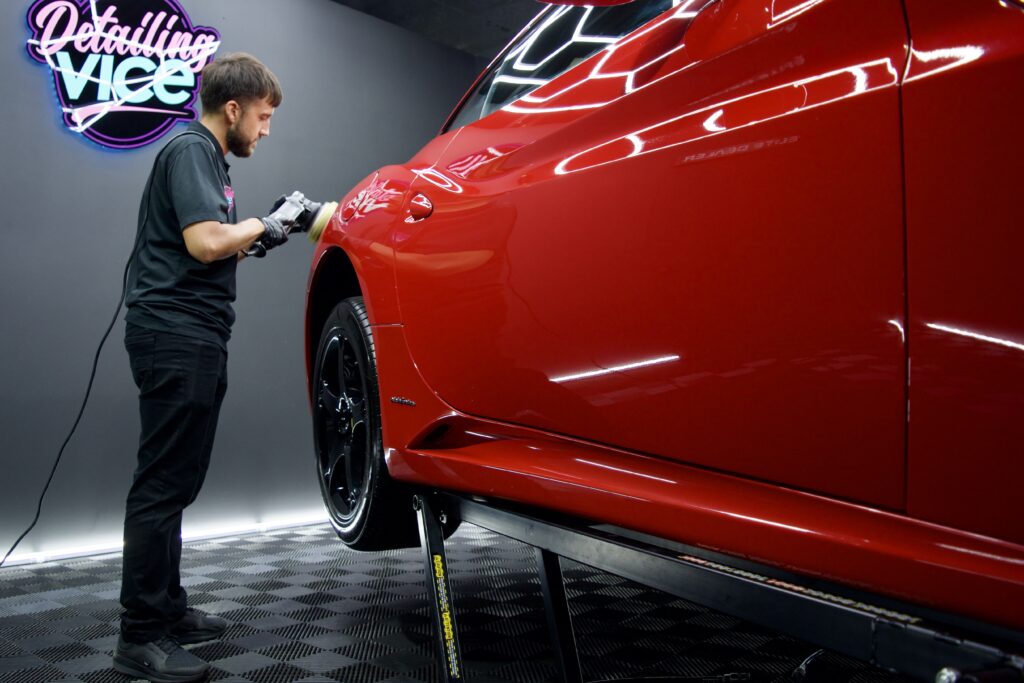
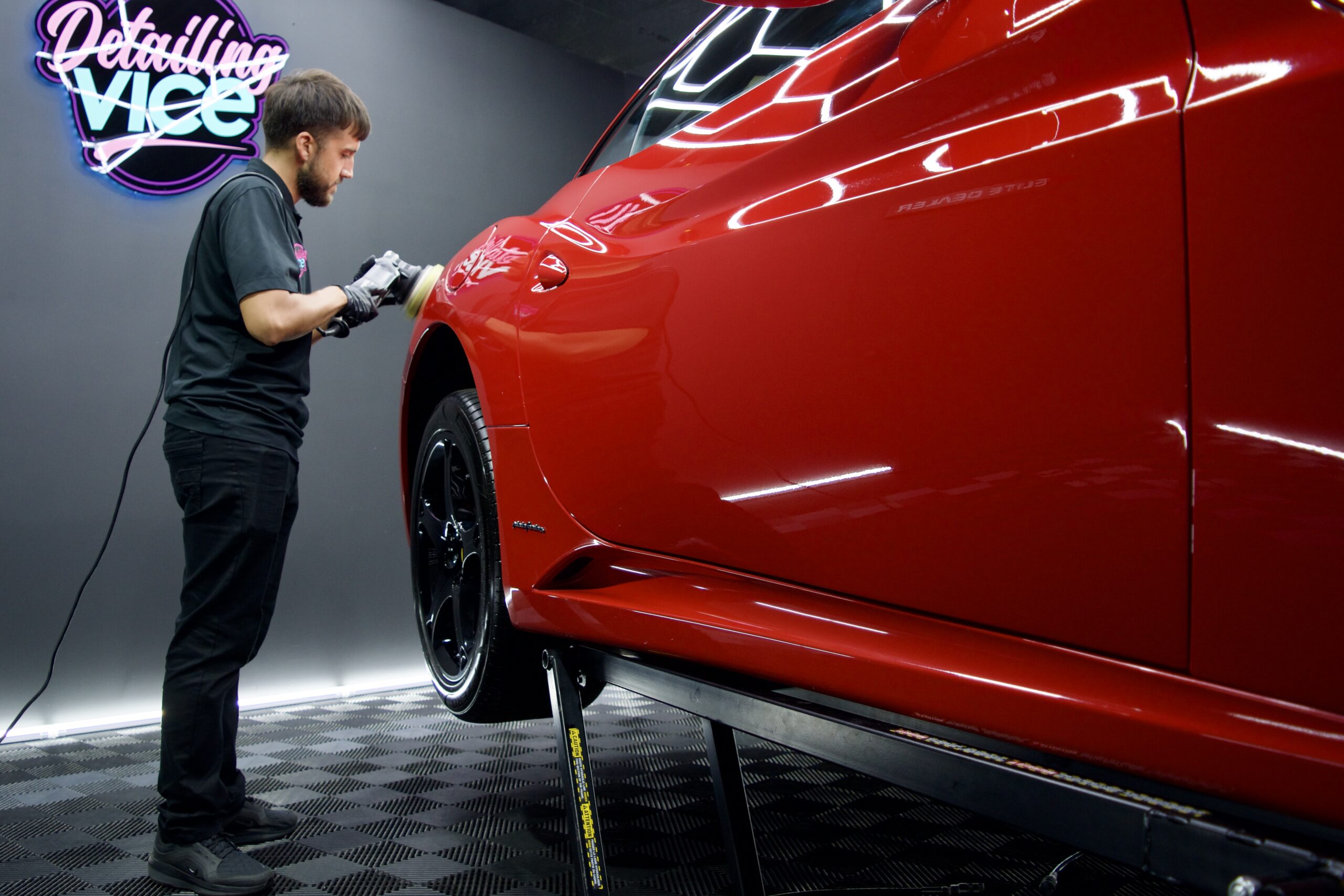
You’ve seen it happen. A car rolls out of the wash looking clean, you park it in the Miami sun, and there they are. A spiderweb of fine circular scratches dancing across the hood every time the light hits it. Those are swirl marks, and they’re the single most common reason a good paint correction in Miami stops looking like one.
Paint correction in Miami is how you get that finish back, and done right, better than it’s ever looked. The trouble is that the term gets thrown around loosely. It ends up slapped onto everything from a real multi-stage machine polish to a quick glaze that hides defects for a month. This guide covers what paint correction actually is, how to tell whether your car needs it, and why the who matters just as much as the process, especially on paint you can’t afford to get wrong.
What paint correction actually is
Paint correction permanently removes defects from a car’s finish by leveling the paint itself. It doesn’t fill them or hide them. Using a machine polisher, graded pads, and abrasive compounds and polishes, a detailer removes a microscopically thin layer of clear coat (or, on a classic, the single-stage surface) until the surrounding paint sits level with the bottom of each scratch. Once the surface is flat again, light reflects evenly, and the finish reads as deep, glossy, and mirror-clear.
The defects true correction removes include:
- Swirl marks, the fine circular scratches that come from improper washing and drying.
- Spider-webbing and wash marring left by automatic car washes and dirty towels.
- Light to moderate scratches that haven’t gone through the clear coat.
- Oxidation, the dull, chalky haze that builds up on neglected or sun-baked paint.
- Water spots and etching from mineral deposits and acidic contamination.
- Buffer trails and holograms left behind by a previous, careless polish job.
The key word is permanent. A glaze or a filler-heavy product can make swirls disappear for a few weeks, then wash away and leave them right where they were. Real correction removes the defect. It doesn’t come back after the next rain.
Correction vs. a polish vs. a coating, cleared up
These three terms get used interchangeably, and they shouldn’t be. Here’s the honest breakdown.
- Paint correction removes defects by leveling paint. It’s the restorative step, the one that actually fixes the finish.
- A polish or enhancement usually means a lighter, single-stage version of correction. It’s a gloss boost that reduces defects without fully removing them. Perfectly valid, as long as it’s sold as what it is.
- A ceramic coating or wax is protection, not correction. It seals and protects the finish, but a coating locks in whatever is underneath it, which is the whole reason correction has to come first.
That last point is the one that costs people the most money. A ceramic coating magnifies and preserves every swirl mark under it. Coat a car that was never properly corrected and you’ve just sealed the defects in for the life of the coating. Correct first, then protect. Never the other way around.
The stages of paint correction
You’ll see correction advertised as one-step, two-step, or multi-stage. That number refers to how many distinct compounding and polishing passes the paint needs, and it’s dictated by the condition of the finish, not by a menu.
- One-step (enhancement). A single combined pass that removes lighter defects and boosts gloss. Great for newer cars, well-kept finishes, or paint that just needs refreshing. It typically recovers a meaningful share of a car’s clarity.
- Two-step. A cutting pass to remove deeper defects, followed by a refining pass to restore clarity and depth. This is the workhorse for most cars with real swirling and moderate scratches.
- Multi-stage. Three or more passes for heavily damaged, oxidized, or neglected paint, and for concours preparation where the standard is perfection under show lighting. This is careful, hours-long work.
More stages isn’t automatically better. More stages means more paint removed, and clear coat (or single-stage color) is a finite resource. A good detailer removes the least paint necessary to reach the goal, which is why every correction should start by actually measuring and reading the paint instead of guessing.
How to tell if your car needs paint correction
A few honest tests you can run in your own driveway:
- The direct-sun test. Roll the car into full Miami sun and look across the hood and roof at an angle. Circular swirls and spider-webbing show up right away.
- The single-light test. At night, shine a phone flashlight or a single bulb across a panel. Defects that hide in daylight jump out under a hard point of light.
- The depth test. Does the paint look flat and hazy instead of deep and wet? Oxidation and light marring dull the reflection long before the color itself fades.
- The fingernail test for scratches. Gently drag a fingernail across a scratch. If it catches, the scratch has probably gone through the clear coat and may not fully correct. An honest detailer will tell you what can and can’t be removed before starting.
Good candidates for correction include daily drivers that have only ever seen tunnel washes, a used car you just bought that looks tired, a classic whose finish has gone flat with age, or an exotic you want flawless before a show or a coating. If any of that sounds like your car, it’s worth an inspection.
Why Miami cars swirl faster than most
If your finish seems to pick up swirls and haze quicker here than it did somewhere else, it’s not your imagination. South Florida stacks nearly every paint stressor at once, so the damage shows up in the clear coat sooner.
- Relentless UV. Intense year-round sun speeds up oxidation and fade, and it makes existing swirls far more visible, because bright overhead light is exactly what reveals them.
- Frequent washing. Salt air, humidity, and afternoon storms mean cars here get washed constantly, and each improper wash, especially at a tunnel or with a dirty mitt, adds a fresh layer of marring.
- Contamination that etches. Coastal salt, industrial fallout, love bugs in season, and acidic rain all bond to and bite into paint. Left on the surface, they create the water spots and etching that correction has to remove.
- Heat-baked contaminants. Something that might rinse off easily in a milder climate gets baked onto a Florida panel within hours, which makes it harder to remove safely later.
None of that means Miami paint is doomed. It means correcting the finish and then protecting it is far more valuable here than in a mild climate. Correction resets the paint, and protection keeps this environment from undoing the work by the next storm.
Why who does it matters more than the price
Here’s the uncomfortable truth about paint correction. It’s one of the few detailing services where a bad job does permanent damage. Because correction works by removing paint, a rushed or unskilled operator can:
- Burn through the clear coat on an edge or a high spot, an irreversible failure that requires a respray.
- Leave holograms and buffer trails that then need another correction to fix, thinning the paint even further.
- Over-correct thin or original paint, using up a margin that can never be replaced.
That risk climbs sharply on two kinds of cars, and they happen to be exactly the cars we build the studio around. Exotics carry fragile factory-correct finishes and carbon-fiber panels where the tolerances are unforgiving. Classics with single-stage paint have no clear coat at all, so every pass removes actual color and there’s no room for a heavy hand. On those finishes, correction isn’t a commodity service. It’s a specialty.
At Detailing Vice, correction starts with reading the car, its paint type, its thickness, its history, and removing the least paint necessary to reach the result. On a McLaren or a numbers-matching classic, restraint is the skill. Anyone can cut hard. Knowing when to stop is what protects your car.
What paint correction in Miami looks like at Detailing Vice
- In-person inspection. We evaluate the finish, identify the paint type and condition, and set a realistic target for what correction can achieve on your specific car.
- Test section. We correct a small area first to confirm the safest, most effective combination of pad, compound, and technique before committing to the whole vehicle.
- Staged correction. Compounding and polishing in our climate-controlled studio, matched to the era and material of the car, with a light hand on anything original or fragile.
- Protection. With the finish corrected, we lock it in with ceramic coating, PPF, or a sealant, so the results last instead of dissolving in the next few washes.
- Delivery and documentation. Your car returns showroom- or concours-ready, with a record of the work and a maintenance plan to keep it that way.
Frequently asked questions
The correction itself is permanent. Those defects are gone for good. How long the finish stays flawless depends on how the car is washed and protected afterward. Pairing correction with a ceramic coating and good wash habits is what keeps swirls from coming back.
It removes defects that sit within the clear coat or paint layer. Scratches deep enough to catch a fingernail may have gone through the clear coat and can only be reduced, not erased, without paint. We tell you honestly what’s correctable before we begin.
In the right hands, yes, but single-stage and lacquer finishes call for a completely different, preservation-first approach because every pass removes actual color. This is our core specialty, and we always test a section first.
It’s strongly recommended. Correction gives you a flawless finish, and a coating or sealant protects that investment so it lasts. Without protection, new swirls can start forming with the next improper wash.
It depends on vehicle size, paint condition, and how many stages the finish needs. That’s why every quote follows an in-person inspection instead of a flat online price. We won’t know what your paint needs until we read it.
Our studio is at 1600 NE 205th Terrace, Miami, FL 33179, and we handle paint correction for daily drivers, classics, and exotics across Aventura, Sunny Isles, North Miami Beach, Hallandale, and Hollywood, with pickup available throughout South Florida. Book an in-person inspection to get started.
See what your paint could actually look like
Most people have never seen their car’s paint fully corrected, only cleaned. The difference, under Miami sun, is hard to believe until it’s parked in front of you. If you’ve been searching for paint correction in Miami and your finish has gone flat, swirled, or tired, the first step is simply letting us read it in person.
Every correction starts with an in-person inspection. Book a paint correction consultation