Paint correction cost in Miami usually lands somewhere between $500 and $3,000, and the gap comes down to one thing: hours. Correction is priced by labor, not by product. A one-step polish on a well-kept daily driver and a three-stage correction on a black Bentley with ten years of automatic car wash damage are the same service in name only. Here’s what separates them, and how to read a quote without guessing.
What You’re Actually Paying For
Polish is cheap. Time is not. A correction quote is essentially an estimate of how many hours a technician will spend behind a machine polisher, panel by panel, plus the prep that has to happen before a pad ever touches the paint.
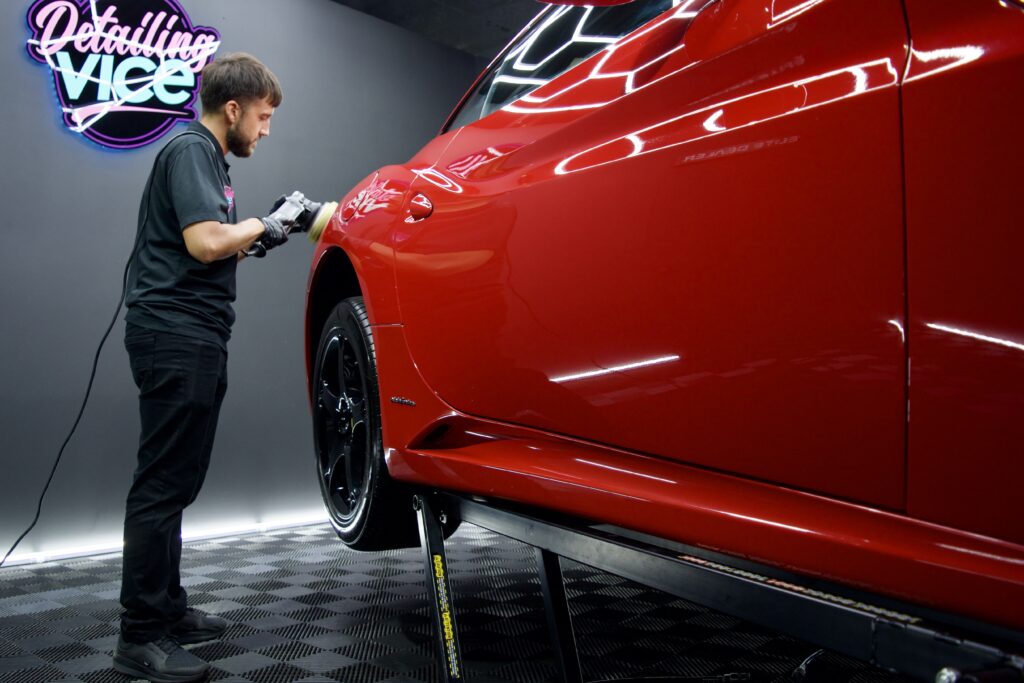
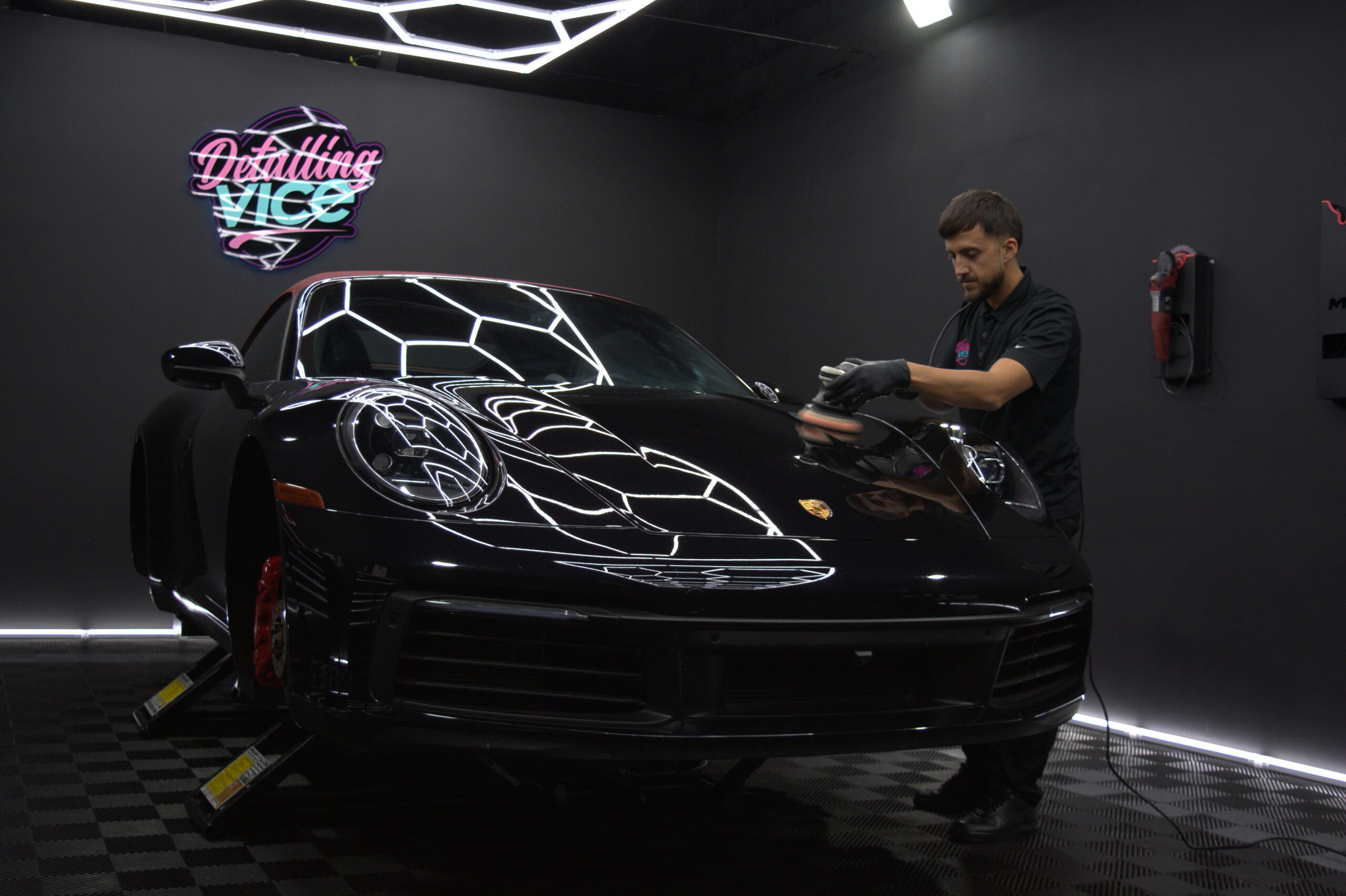
That prep is not optional. The car gets a decontamination wash, iron removal to pull embedded brake and rail dust out of the finish, and a clay or mitt treatment to lift bonded contamination. Skip it and you drag grit across the paint at 4,000 RPM. Then the paint gets measured and inspected under a combination of light sources, because swirls that vanish under a shop’s overhead LEDs will be obvious in Miami sun on the Julia Tuttle.
Only then does the actual correction begin. On a mid-size sedan in fair condition, that might be six to eight hours. On a Rolls-Royce with heavy defects and a lot of complex panel geometry, it can run three to four days.
One-Step vs Multi-Stage Correction
The number of “stages” refers to how many separate machine passes the paint gets, each with a different pad and abrasive combination. More stages mean more defect removal and more hours.
One-Step Correction
A single pass with a medium-cut polish. It typically removes 60–80% of light swirling and restores most of the gloss. It won’t touch deeper scratches or heavy oxidation.
Best for: newer vehicles, leases, cars in good shape that need a reset before a coating. Typical South Florida range: $500–$900.
Two-Stage Correction
A cutting pass to level the defects, then a refining pass to remove the haze the first pass leaves behind. This is the standard for most cars that have seen a few years of Miami weather and the occasional tunnel wash.
Expect 85–95% defect removal. Typical range: $900–$1,800.
Three-Stage and Concours-Level Correction
A compound pass, a polish pass, and a final jeweling pass to maximize depth and clarity. Reserved for show preparation, dark or soft paint, single-stage lacquer on classics, and cars where the finish is part of the value.
This is measured in days, not hours. Typical range: $1,800–$4,000+, and higher on large or complex vehicles.
Your Clear Coat Is Finite
This is the part most price comparisons leave out, and it matters more than the number on the quote.
Correction works by removing a microscopic layer of clear coat so the surface sits level with the bottom of the scratch. Factory clear coat is roughly 35 to 50 microns thick. A light polishing pass removes about 1 to 2 microns; an aggressive compounding pass can remove 4 to 5. Manufacturers generally consider it unsafe to remove more than about 25% of the clear over a car’s lifetime.
Do that math and the picture gets clear fast. A car can handle a handful of serious corrections across its life, not an annual one. That’s why a shop that measures paint thickness with a gauge before quoting is protecting you, and one that quotes a “full correction” over the phone without seeing the car is not.
Repainted panels are the real hazard. Body shop refinish work is often thinner and softer than factory clear, and a blend can leave uneven thickness across a single fender. Reading the gauge is the only way to know before a pad is on the paint.
When Correction Isn’t the Right Call
Taking a position here is more useful than selling everyone the same package.
Skip or reduce the correction when:
- Paint readings come in thin. Under roughly 90 microns total, aggressive work stops being worth the risk. A light finishing polish and protection is the smarter play.
- The car is a short-term lease. A one-step and a good sealant will look excellent for the remaining term at a fraction of the cost.
- You’re chasing deep scratches. If your fingernail catches in it, correction won’t remove it without going past safe limits. That’s a touch-up or refinish conversation.
- The car is an original-paint classic with honest patina. Single-stage lacquer and original enamel have no clear coat at all — the color layer is the surface. Correcting it removes pigment permanently. Sometimes preservation beats perfection, and that call should be made with the owner before anything starts.
Why Miami Paint Degrades Faster
The same car will need correction sooner here than it would in Denver, and it’s worth knowing why before you assume your paint was defective from the factory.
UV load runs high year-round, which accelerates oxidation and clear coat breakdown. Cars parked within a few miles of the coast pick up salt aerosol that settles on horizontal panels and stays there. Summer afternoon storms leave mineral-heavy water that bakes into etched spots within hours if the car dries in direct sun.
Then there’s love bug season. Florida gets two generations a year, roughly April–May and August–September, and their remains are acidic enough to etch paint if they sit. A weekend on the road during peak flight can leave marks on a front clip that a wash alone won’t remove.
None of this is a reason to correct more often. It’s a reason to protect the paint after correcting it once, properly, so you don’t have to keep spending clear coat. Most owners pair correction with a ceramic coating or paint protection film for exactly that reason.
What a Real Quote Should Include
Before you compare two numbers, make sure they describe the same work. A quote worth trusting should tell you:
- Paint thickness readings, panel by panel, and any areas flagged as thin or previously repainted
- The number of stages, and the realistic defect removal percentage being targeted
- Whether decontamination and iron removal are included or billed separately
- What happens to the paint afterward — bare corrected paint starts collecting swirls again on the first wash
- Whether trim, glass, and door jambs are in scope
If a shop quotes a flat price sight unseen, they’re either padding for the worst case or planning to cut the job short. Neither one helps you.
Frequently Asked Questions
Most paint correction in Miami costs between $500 and $3,000. A one-step polish typically runs $500–$900, a two-stage correction $900–$1,800, and multi-stage or concours-level work $1,800–$4,000 or more. Price is driven by labor hours, which depend on the vehicle’s size, paint condition, and paint hardness.
A one-step correction on a standard sedan takes six to eight hours. A two-stage correction usually takes one to two full days. Multi-stage work on a large or heavily defected vehicle can take three to four days. Ceramic coating application and curing add additional time on top of that.
Most vehicles can safely handle three to five meaningful corrections over their lifetime. Factory clear coat is only 35–50 microns thick, and each correction removes 1–5 microns. A paint thickness gauge reading is the only reliable way to know how much working room a specific car has left.
No. Correction removes defects that sit within the clear coat, such as swirl marks, wash marring, light oxidation, and water spot etching. If a scratch catches your fingernail, it has gone through the clear into the base coat and requires touch-up or refinishing instead.
In almost every case, yes. A coating locks in whatever the paint looks like underneath it for years. Applying one over swirled paint seals in the swirls. At minimum, a light one-step correction should be done first so the coating is protecting a clean finish rather than preserving a damaged one.
It can, but it requires a completely different approach. Single-stage lacquer and original enamel have no clear coat, so any polishing removes pigment directly. Work is done by hand or at very low speed with minimal abrasive, and on some original finishes the right decision is to preserve the patina instead.
Get an Honest Read on Your Paint
Every quote at Detailing Vice follows an in-person inspection, because the number depends entirely on what the gauge and the lights say. We’ll measure the paint, show you the defects under proper lighting, and tell you plainly whether your car needs one stage or three — including when the answer is that it doesn’t need much at all.
We’ve been correcting paint in Miami since 2014, on everything from concours classics with original single-stage finishes to modern exotics fresh off the truck. Bring the car by the studio at 20346 NE 16th Pl, or call (786) 357-1383 to set up an inspection.